
Wrapping · By Brock Timperley
Car Wrap Colours and Finishes: Gloss, Satin, Matte and Chrome
Most people arrive at the workshop knowing they want a colour change and not much else. They have seen a satin grey ute on the motorway, or a chrome delete on a car like theirs, and they want that. Then they see the swatch books and realise how many decisions sit behind the word “black”.
Colour is the fun part. Finish is the part that changes how the car looks in daylight, how much work it is to keep clean, and what your quote comes to.
Here is the short version. Gloss looks like factory paint and is the easiest finish to live with. Satin sits in between, soft and expensive-looking without being high maintenance. Matte has the biggest visual impact and asks the most of you in return. Colour-shift, chrome and brushed-metal films cost more per metre and are less forgiving to install, so specialty finishes sit at the top end of a quote. Every one of them is reversible, so none of these choices is permanent.
Below we go through what each finish family actually looks like on the road, what it is like to own, and how your choice moves the price.
Gloss: The Safe Choice, and Not a Boring One
Gloss is the finish most people already know, because it is what almost every car leaves the factory wearing. Light bounces straight off it, colours look deep, and reflections are sharp.
That familiarity is exactly why it works so well for a colour change. A gloss wrap in a colour your car was never offered in reads as a factory finish rather than a modification, which is the look a lot of owners are after. It is also the most forgiving finish to own, because it washes like paint and light marks are far less obvious on it than on a flat finish.
The one honest catch is the same one gloss paint has. On very dark colours, black especially, swirl marks from poor washing show up under direct sun. That is a washing problem rather than a wrap problem, but it is worth knowing before you commit to gloss black.
Satin and Matte: Where the Head Turns Happen
Satin sits between gloss and matte, and it is the middle ground for someone who wants their car to look different rather than just recoloured. It has a soft sheen that catches light along a body line instead of reflecting the sky, which makes the shape of a car much easier to read. Satin greys, blacks and dark blues show that effect particularly well.
Matte goes all the way flat. No sheen, no reflection, just colour. It is the most dramatic finish available and it makes a car look purposeful, particularly on something with strong panel work.
The trade-off with both, and matte in particular, is care. A flat finish cannot be polished or buffed, because there is no gloss layer to cut back, so marks are dealt with by washing correctly in the first place rather than by machine work afterwards. Wax and traditional polish stay away from it too, since those products add shine to a surface built not to have any.
None of that is hard, it is just a different habit. Owners who enjoy looking after their car tend to love matte. Owners who want to run it through a service station wash on a Sunday are usually happier in satin or gloss.
Chrome, Metallic and Carbon Fibre: The Specialty End
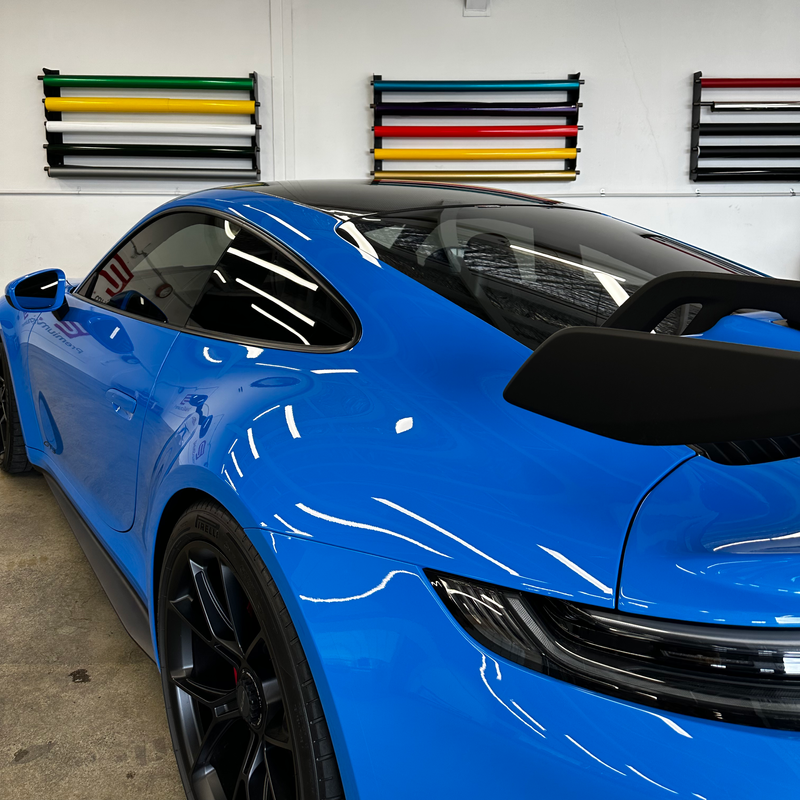
Beyond the three main families sit the specialty films. We offer metallic, chrome, carbon fibre and textured finishes alongside gloss, satin and matte, with hundreds of individual colours across all of them and specialty films available on request.
Metallic and pearl-effect films behave like metallic paint. Fine flake or pearl particles in the film catch sunlight and give the colour a depth that shifts as you walk around the car. This is the middle ground if a solid colour feels flat to you but a full chrome is too much.
Chrome is the loudest finish there is, essentially a mirror. It gets attention, and it is demanding to install because the film shows every imperfection underneath and every join, so it is more commonly used as an accent than as a full colour change.
Carbon fibre is a textured film with a woven look, mostly used on parts rather than whole cars. Roofs, bonnets, mirror caps and spoilers are the usual candidates.
The most popular specialty job of all is the simplest. A chrome delete wraps the chrome window surrounds, grille and badges, typically in black, and starts from $499. It is one of the highest-impact, lowest-cost modifications you can make.
How Finish Choice Moves Your Quote
Finish is not just a styling decision, it is a line in the price. Premium films cost more per metre and are less forgiving to install, and install time is the single biggest driver of any wrap quote. Here is how the families compare.
| Gloss | Satin | Matte | Chrome, metallic, carbon fibre | |
|---|---|---|---|---|
| Look on the road | Factory paint | Soft sheen, shows body lines | Flat, high impact | Specialty, attention-grabbing |
| Ease of care | Easiest | Easy | Most demanding | Varies, generally demanding |
| Can be polished | Yes | No | No | Varies by film |
| Effect on quote | Lowest | Low to middle | Middle to higher | Highest for chrome and colour-shift |
A full vinyl wrap on a standard car in New Zealand typically costs between $3,500 and $6,000, and for a standard hatch or sedan in a straightforward gloss or satin colour you are usually in the lower-to-middle part of that range. Colour-shift, chrome, brushed-metal and some satin or matte films push it higher.
If you want a colour change nobody questions, gloss is the pick and the least expensive way to do it.
If you want the car to look different without a maintenance project, satin is the sweet spot.
If you want maximum impact and you enjoy detailing, matte delivers a look nothing else does, as long as you are honest about the washing.
If you want an accent rather than a new colour, a chrome delete, a carbon fibre roof or black mirror caps get you a long way for a fraction of a full wrap.
Our guide to how much it costs to wrap a car in NZ has the full breakdown, and you can see the finishes we carry on the vehicle wrapping page.
You Are Not Stuck With It
The best part of this decision is that it is not permanent. Vinyl is fully reversible. It comes off cleanly and leaves the factory paint underneath untouched, and while it is on it shields that paint from UV and light scratches. A quality wrap typically lasts five to seven years depending on care and sun exposure, so you can run a satin grey for a few years and go back to the original colour, or something else entirely, later on.
Every wrap we fit is backed by the manufacturer’s warranty covering peeling, lifting, cracking and excessive fading, with terms varying by film brand and type. If the wrap changes the main colour of the vehicle, you update the colour on record with the NZTA, which is a simple process.
One last thing worth knowing. If you want a colour change that also protects the paint properly, coloured paint protection film is a genuine alternative. It is a thicker urethane film with a self-healing surface and a smoother, paint-like finish with no orange peel texture, which is especially noticeable on dark colours. We have compared the two in our guide to coloured PPF versus vinyl wrap.
If you are stuck between two finishes, bring the car in. A swatch on a bench and the same swatch held against your own panels in daylight are two very different things, and we would rather you saw it properly than guessed from a screen. Get a free, no-obligation quote here.
Frequently Asked Questions
What car wrap colours and finishes can you get in NZ?
We offer gloss, matte, satin, metallic, chrome, carbon fibre and textured finishes, with hundreds of individual colours available across all the finish types. If you have seen a specialty film that is not in our standard range, we can usually source it on request. The best starting point is to tell us the look you are chasing rather than a specific product code, and we will show you what is available in that direction.
Is a matte wrap harder to look after than a gloss wrap?
Yes, a little. Matte and satin films cannot be polished or buffed, so marks are removed by careful washing rather than by cutting the surface back, and you need to avoid wax and polish products made for gloss paint. It is not difficult, it is just a different routine. Looked after properly, a quality vinyl wrap typically lasts five to seven years depending on care and sun exposure.
Does the finish I choose change the price of the wrap?
It does. A full vinyl wrap on a standard car in New Zealand typically costs between $3,500 and $6,000, and for a standard hatch or sedan in a straightforward gloss or satin colour you are usually looking at the lower-to-middle part of that range. Colour-shift, chrome, brushed-metal and some satin or matte films cost more per metre and are less forgiving to install, so the same car in one of those finishes sits higher. The only accurate number is a quote on your actual car.
How much does a chrome delete cost?
A chrome delete starts from $499. It involves wrapping the chrome trim pieces on your vehicle, meaning the window surrounds, grille and badges, in vinyl, typically black. It gives a clean, modern look and is one of the highest-impact, lowest-cost changes you can make to a car.
Does a vinyl wrap damage the paint underneath?
No. A quality wrap is fully reversible, so it comes off cleanly and leaves the factory paint underneath untouched. While it is on, the film protects that paint rather than harming it, which is a large part of why owners who care about resale value choose a wrap over a respray.
Do I need to tell anyone if a wrap changes my car's colour?
Yes. Wrapping your car a different colour is legal in New Zealand, but if the wrap changes the main colour of the vehicle you are required to update the colour on record with the NZTA. It is a simple process, and we can point you in the right direction when you pick the car up.